Shoulder surgery
I. Anaesthesia and post-operative pain management
We perform all our shoulder surgical procedures, whatever the method, arthroscopic or "open", under general anaesthesia. We do not combine this with a loco-regional interscalene block anaesthesia.
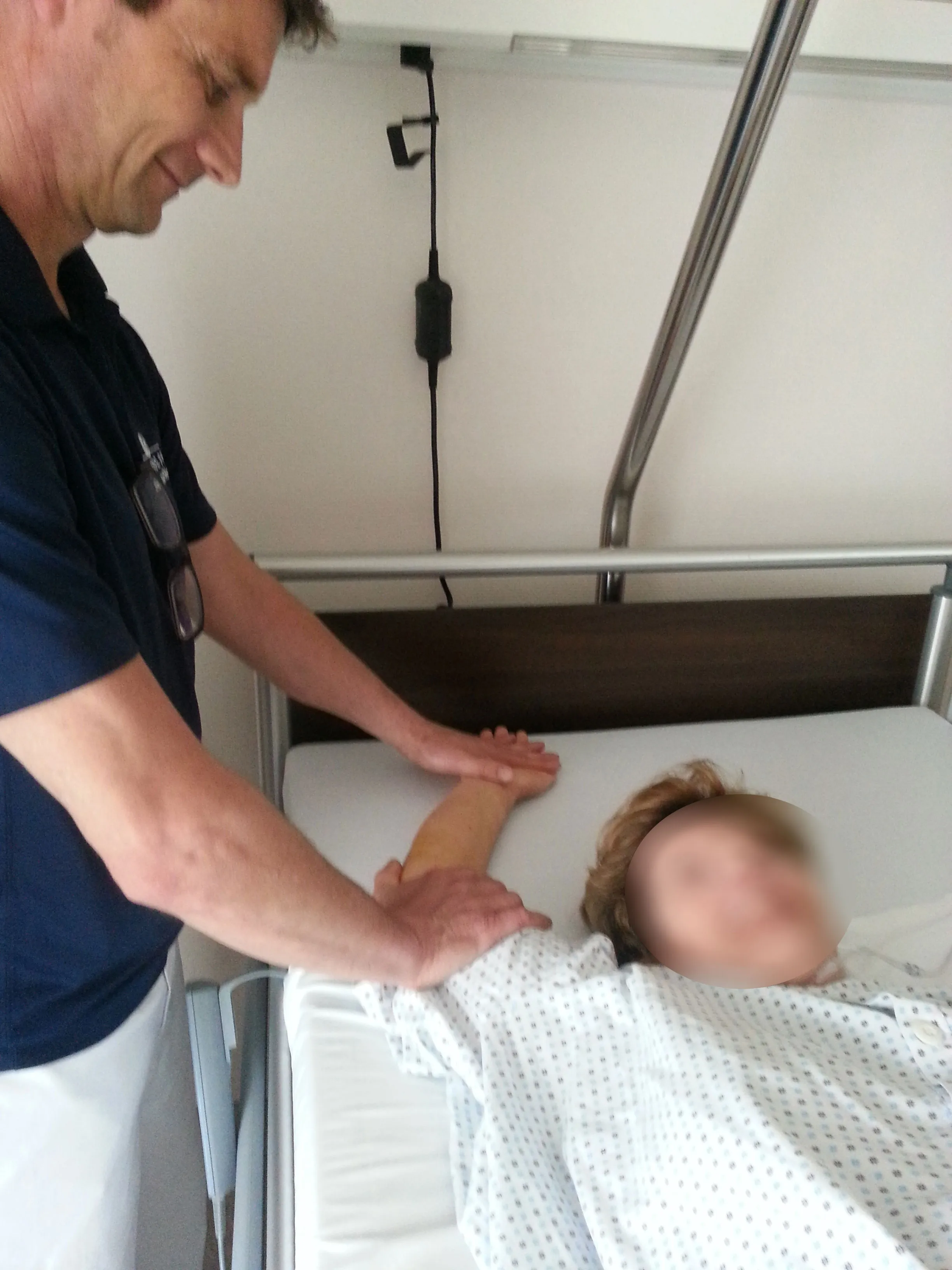
Immediate post-operative pain is fully controlled with painkillers. A morphine pump may be used for patients with above-average pain. But, in our experience, it is above all immediate post-operative passive mobilisation of the operated shoulder, combined with cryotherapy (ice packs on the shoulder), that best relieves post-operative pain.
Patients operated on arthroscopically, unlike those operated on "open", could in theory go home the evening of the day of surgery, after their first passive mobilisation session with the physiotherapist. This is what is known as outpatient surgery. In practice, we prefer to keep the patient in hospital overnight, or even 2 to 3 days if they are elderly or live alone.
Patients operated on by conventional "open" surgery remain hospitalised in our shoulder unit for an average of 4 days after surgery for instability in an athlete, and 7 days after a total shoulder prosthesis.
II. The two methods of shoulder surgery
The surgical procedure can be carried out either through small 2-4 mm skin incisions, with the image supplied by a micro-camera inserted into the shoulder monitored on a television screen (arthroscopic surgery), or through a skin incision of about ten centimetres and an opening of the muscular wall ("open" surgery).
We practise arthroscopic shoulder surgery, which we learned during our stays in the United States since the 1990s…
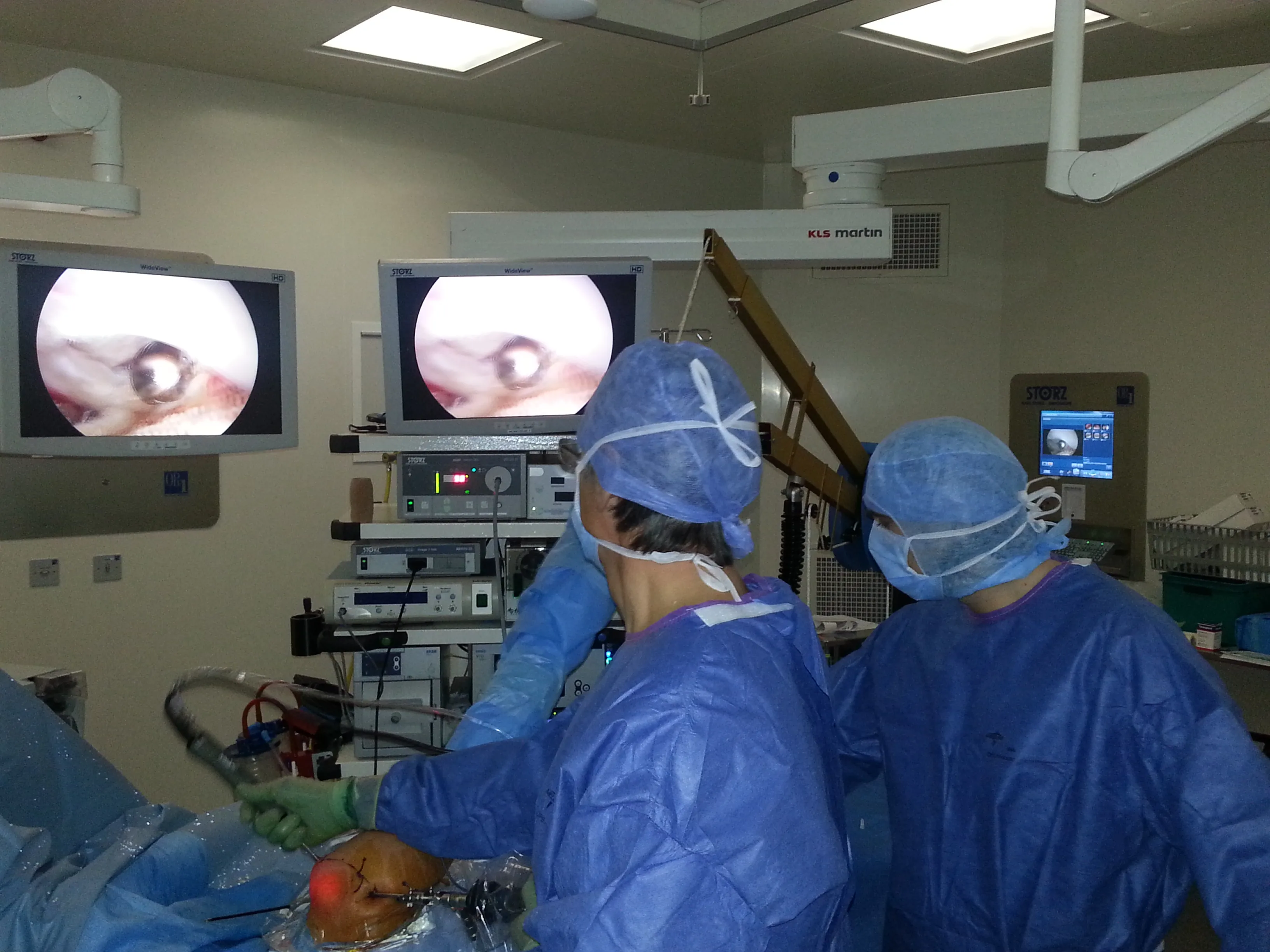
- The principle, revolutionary in the late 1980s, is to perform a very precise technical procedure inside the shoulder, guided by an image supplied by a micro-camera inserted into the shoulder and broadcast onto a television screen in front of the operator.
- A pump continuously circulates sterile saline in and out, with the operator able to adjust pressure and flow at will, ensuring excellent visibility of the tissues inside the shoulder.
- Specific surgical instruments, no larger than 5 mm, are used for this arthroscopic microsurgery.
The advantages of this arthroscopic shoulder microsurgery are well recognised:
- There is theoretically no risk of infection, because the continuous in-and-out flow of sterile saline prevents any microbial penetration through a continuous washing effect on the shoulder.
- Post-operative pain is low due to the absence of any opening of the shoulder muscles.
- Aesthetic advantages: the scars from the 3 to 4 small micro-incisions are practically invisible.
We perform 80% of our shoulder surgical procedures using the arthroscopic method:
- Removal of a rotator cuff calcification
- Removal of an aggressive acromial spur affecting the rotator cuff
- Repair of a rotator cuff tear
- Debridement of a massive, irreparable rotator cuff tear with tenotomy of a severely degenerated long biceps
- Ligament re-attachment of a Bankart lesion in an athlete
We operated on all our patients using the "open" method from 1986 to 1992, before arthroscopic shoulder microsurgery became reliable and reproducible. "Open" shoulder surgery represents about 20% of our surgical practice today.
- The post-operative infection risk is never zero. The risk of post-operative infection is increased in certain patients with specific medical histories: poorly controlled diabetes, recurrent urinary infections, poor dental hygiene, skin acne.
- Immediate post-operative pain is nowadays perfectly managed through a combination of effective therapeutic means: non-systematic anti-inflammatories and morphine pump, painkillers, immediate post-operative passive mobilisation, and systematic ice packs on the operated shoulder.
- The quality of the scar always receives our attention. But it is the patient who "makes" their scar… For example, a patient with constitutional hyperlaxity (overly flexible joints) will often produce a poorer-quality scar.
Today we reserve the "open" method for three types of shoulder pathology:
- The vast majority of unstable shoulders in athletes (recurrent anterior dislocations and subluxations). We perform, "open", what we call a triple lock of the shoulder (bone, muscle and ligament), also known as the "modified Bristow-Latarjet procedure".
- Centred primary omarthrosis requires an "anatomical" total shoulder prosthesis that works with the rotator cuff tendons.
- Eccentric omarthrosis, with a massive, irreparable rotator cuff tear, requires a "reverse" total shoulder prosthesis that works with the deltoid muscle.
Rehabilitation, post-operative recovery and functional outcomes after each type of surgical procedure are detailed in the "Rehabilitation" and "Functional Results" chapters.